
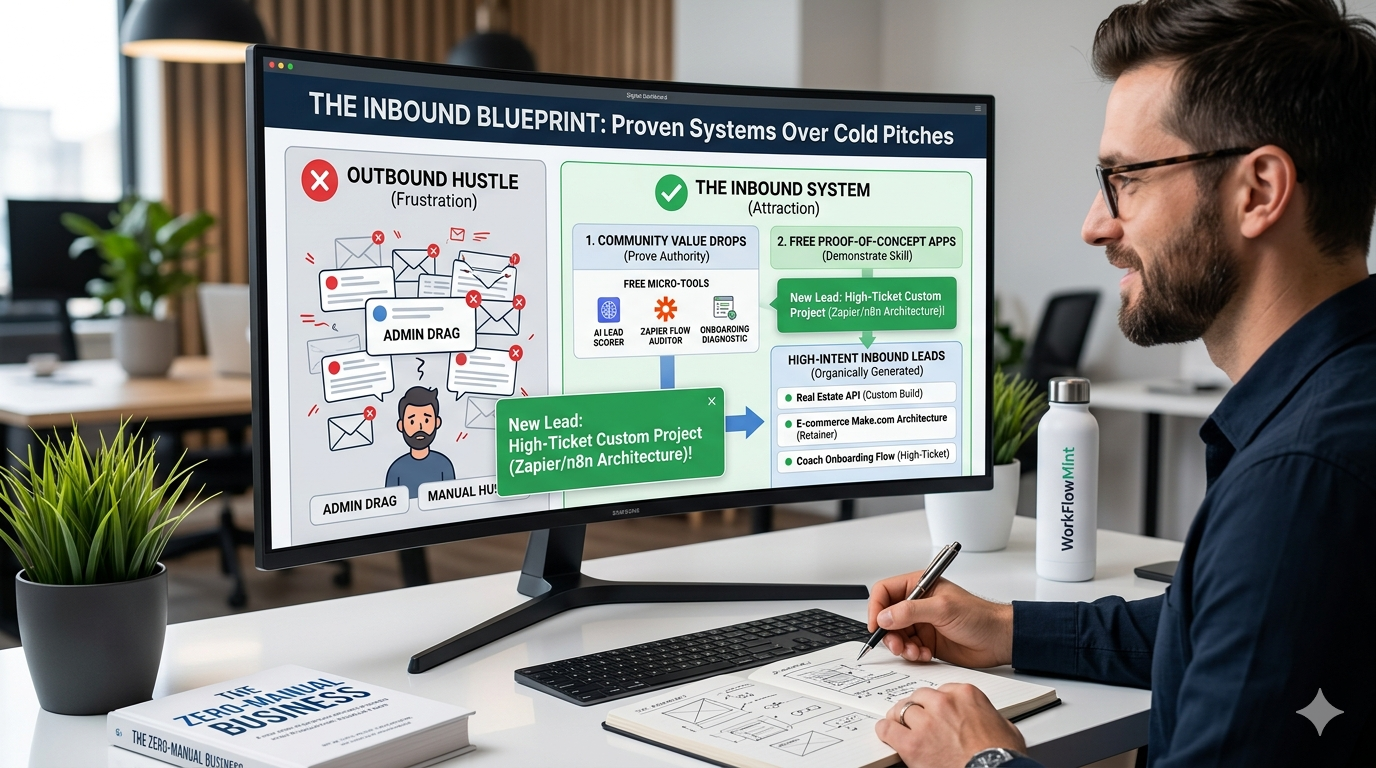
If you are trying to get automation clients right now, you have likely run into a frustrating wall: finding the work is significantly harder than actually building the workflows.
You map out elegant systems. You know exactly how to shave twenty hours off a solopreneur’s workweek by connecting their disparate tools. Yet, when you send out cold outreach to offer these solutions, the response rate is abysmal. It often feels like shouting into an empty void.
The conventional advice for growing a freelance automation business is treated like a brute-force numbers game. Send more emails, scrape more contacts, pitch harder. But this fundamentally misunderstands what a Zapier / Make / n8n consultant is actually selling. You are not selling a simple logo design or a basic website tweak. You are asking a business owner to hand over the API keys to their Stripe account, their CRM, and their customer inbox.
That requires a level of trust that a cold, unsolicited message simply cannot build. The stakes are too high for the client.
The shift that actually works and the one that consistently generates high-quality automation agency leads is moving from outbound shouting to inbound demonstration. When you play the long game of inbound marketing, you stop pitching and start proving. Instead of interrupting a busy agency owner to explain how you can fix their onboarding, you build systems that naturally attract them to you.
Here is why an inbound approach reclaims your time and fills your pipeline:
- Zero-Friction Trust: Prospects see your solutions in action before they ever speak to you, bypassing the skeptical “sales call” phase.
- Higher Retainers: When clients come to you based on your demonstrated expertise, they view you as a consultant, not a cheap, interchangeable commodity.
- Scalable Lead Generation: A single WorkFlowMint automation blueprint or highly detailed forum comment acts as a silent salesperson working around the clock.
As a trusted architect of business systems, your goal is to showcase your ability to eliminate “admin drag.” In this guide, we are breaking down five highly practical, zero-hype strategies to attract the exact clients who need your help. Let’s look at how successful builders are leveraging community-led growth principles to scale their operations without ever sending another spammy message.
The Shift: Why Outbound Fails the Freelance Automation Business
There is a profound disconnect between the high-level technical work of a system architect and the low-level grind of traditional sales tactics. Many highly skilled technicians attempt to scale their freelance automation business using the exact same outbound playbook as a generic copywriter or lead generation agency. They scrape email addresses, load them into an automated sequence, and fire off hundreds of identical messages promising to “save you 10 hours a week.”
The result is almost always deafening silence.
The failure of outbound marketing in this specific niche is not a matter of writing a better subject line. It is a fundamental mismatch between the medium and the message. You cannot sell complex, invisible infrastructure through a cold, disruptive channel.
The “Admin Drag” of Cold DMs
Consider the ultimate irony of the outbound model: as an expert dedicated to eliminating inefficient manual tasks, you are forcing yourself into a highly inefficient, manual sales process. Sending cold direct messages is the epitome of “admin drag.” It requires constant, active effort that yields a notoriously low conversion rate.
When you rely on cold outreach to sell automation services, you are operating on a hamster wheel. The moment you stop sending messages, your pipeline dries up instantly. There is no compound interest for your efforts.
Furthermore, cold pitching instantly positions you at a psychological disadvantage. You are interrupting a busy founder’s day to ask for their time and money. This creates an immediate defensive posture. To get automation clients who respect your expertise and pay premium retainers, you must flip this dynamic. You need to position yourself as the prize the scarce expert whose time is valuable. Inbound methodologies allow you to build digital assets that work passively. You build the asset once, and it generates interest continuously.
Trust is the Ultimate Currency for Automation Agency Leads
To understand why inbound is mandatory, you have to look at the psychology of the buyer. When a business owner hires a Zapier / Make / n8n consultant, they are not buying a simple deliverable. They are handing over the keys to their operational kingdom.
An automation consultant requires access to the company’s lifeblood: CRM platforms, payment processors, marketing databases, and internal communication channels. If a workflow is built incorrectly, the consequences are disastrous. A faulty webhook could double-charge a client, leak confidential customer data, or completely break the onboarding sequence for a high-ticket coaching program.
No rational solopreneur or agency owner will hand over their API keys to a stranger who slid into their LinkedIn inbox. The risk is simply too high.
High-quality automation agency leads require absolute trust, and trust cannot be demanded in a 50-word email; it must be demonstrated. This is where inbound marketing thrives. When a prospect discovers you because you publicly solved a complex routing issue in a technical forum, or because they used a free diagnostic tool you built, the trust barrier is instantly shattered. They do not have to wonder if you understand the technology. You have already provided the proof of concept.
They approach you not as a skeptical buyer evaluating a risky vendor, but as a frustrated business owner seeking the help of a proven authority.
Strategy 1: Prove Your Skills to Get Automation Clients Organically
If outbound marketing is about interruption, inbound is about intersection. You must intersect with business owners precisely at their point of maximum frustration. To get automation clients organically, the most sustainable and high-ROI path is to become the resident problem-solver in highly specific niche communities.
The most consistent source of high-ticket work does not come from running Facebook ads or sending cold emails. It comes from answering complex questions in public forums where business owners are actively seeking help.
Finding Where Your Target Audience Asks Questions
The most common mistake new builders make when trying to scale their freelance automation business is spending all their time in the wrong rooms. If you hang out in the official Zapier forums or the r/Make subreddit, you are surrounded by your peers, not your prospects.
To generate qualified automation agency leads, you must inhabit the spaces where non-technical founders complain about “admin drag.” These are the operational trenches. Look for specialized Discord servers for real estate brokers, private Facebook groups for e-commerce brand owners, or subreddits like r/digitalmarketing and r/SaaS.
In these communities, listen actively for “friction triggers.” These are recurring complaints such as:
- “I spend three hours every Friday manually copying data from…”
- “My virtual assistant keeps missing steps when onboarding…”
- “Is there a way to make tool A talk to tool B without double data entry?”
These complaints are the raw material for your inbound pipeline. When you identify a specific, painful operational bottleneck, you have found the perfect opportunity to demonstrate your architectural expertise.
The Art of the Pitchless Value Drop
Once you spot a business owner struggling with a workflow, the natural instinct is to send a direct message saying: “I can build this for you, here is my calendar link.”
Resist this urge immediately. That is outbound thinking disguised as inbound strategy.
The absolute core of inbound marketing for automation experts is mastering the “Pitchless Value Drop.” This means replying publicly to the thread with the exact, step-by-step solution to their problem without a single link to your calendar or a request for a discovery call.
For example, if an agency owner asks how to stop leads from falling through the cracks, map out the entire architecture in your comment. Explain exactly how a webhook catches the lead, routes it through an AI parser to extract the core data, updates the CRM via API, and sends a formatted Slack notification to the sales team.
Give away the “what” and the “how” completely for free.
This feels deeply counterintuitive to most consultants. Won’t the prospect just take your blueprint and build it themselves? The reality is exactly the opposite. When a busy, time-poor solopreneur reads a highly technical, 10-step architectural breakdown from a professional Zapier / Make / n8n consultant, two distinct things happen:
- Validation: They realize a concrete, automated solution to their massive headache actually exists.
- Overwhelm: They realize the technical execution (handling JSON arrays, configuring webhooks, managing error handling) is far too complex for their current bandwidth.
By exposing the complexity of the solution while simultaneously proving you have mastered it, you trigger a powerful psychological shift. You transition from a random vendor to an established authority. The prospect will not steal your idea; they will hire you to implement it. They will proactively reach out to you, asking to sell automation services to their specific business, bypassing the traditional sales friction entirely because you have already proven your competence.
Strategy 2: Build Free Micro-Tools to Get Automation Clients
The traditional freelance model relies heavily on offering a “free 30-minute discovery call.” For a busy solopreneur actively drowning in operational tasks, another 30-minute meeting is not a gift. It is a burden. It is simply another block taken up on an already crowded calendar.
If you want to consistently attract and get automation clients, you must replace the time-consuming discovery call with instant, tangible value.
This is where the micro-tool strategy becomes your most powerful asset. Instead of promising a prospect that you can build reliable systems, you build a lightweight, fully functional system and give it to them for free. In the wider software landscape, this methodology is known as Product-Led Growth (PLG). By adopting this approach, you are effectively applying an enterprise sales strategy to your solo consulting business, allowing your product to do the heavy lifting of selling.
Translating Pain Points into Proof-of-Concept Apps
The objective here is not to build a massive, complex SaaS application that takes six months to deploy. You are building a highly focused “proof-of-concept” app that solves one highly specific micro-problem. Think of it as a digital appetizer for your target audience.
For example, let us say your target demographic is digital marketing agencies. Their most common bottleneck is often categorizing and scoring incoming lead data. You could spend three to four days building a simple front-end dashboard connected to a Make scenario and an OpenAI processing module.
The user simply pastes a messy transcript from a sales call into your tool. In seconds, the background automation instantly outputs a cleanly formatted, actionable summary alongside an AI-generated lead score.
You then share a link to this micro-tool in the niche communities discussed in the previous section. You drop the link with zero expectations and zero gated email walls. This completely bypasses the traditional sales friction. The prospect does not need to read your resume or trust your marketing copy. They simply trust the tangible result the tool just generated for them.
From Free Tool to High-Paying Retainer
A micro-tool acts as an incredibly effective Trojan Horse for your consulting services. When a business owner uses your free application and saves twenty minutes on a manual task, their immediate next thought is entirely predictable: “How do I connect this directly into my CRM?”
That is the exact moment they transition from a casual, anonymous user into a highly qualified, warm lead.
Because you built the initial tool, you are the undeniable, pre-vetted authority on how to integrate it. They will proactively reach out to ask about custom API integrations, webhook setups, or full-scale data routing. You are no longer fighting to justify your hourly rate to a cold prospect. You are fielding an inbound request from an active user who already loves your work.
To maximize the effectiveness of this strategy, ensure your micro-tool has a clear, low-friction intake form for these custom integration requests. You can even connect this intake form to one of our WorkFlowMint internal routing templates to automatically categorize these high-intent leads inside your own Notion workspace.
By dedicating just a few days to building a concrete, functional asset, you create a permanent lead generation engine. The tool works around the clock, proving your architectural competence while you sleep.
Strategy 3: Optimize Your Positioning as an Inbound Consultant
Once you have established trust through community engagement and micro-tools, the prospect will inevitably click on your profile or website to learn more. This is the critical juncture where interest either converts into a booked inquiry or bounces off the page. To consistently get automation clients, your digital footprint must instantly confirm the high-level authority you demonstrated in the forum or with your free application.
Many highly skilled builders treat their landing pages like a technical resume, exhaustively listing the various APIs, software platforms, and coding languages they have mastered. This is a fundamental positioning error. A busy solopreneur does not care about the underlying code; they care about the operational drag that is stalling their growth. You must position yourself not as a mechanic patching pipes, but as an architect of efficient business systems.
Showcasing Systems Over Software
If your LinkedIn headline or portfolio website simply labels you as a generic Zapier / Make / n8n consultant, you are instantly commoditizing your own expertise. When you focus entirely on the software, you force the non-technical prospect to do the heavy mental lifting of figuring out how that software applies to their specific business. This introduces friction into the buying process.
Instead, you must sell the ultimate outcome. When you want to successfully sell automation services, your positioning should articulate the exact business bottleneck you remove. Instead of stating, “I build complex n8n workflows,” reframe the value proposition entirely to focus on the result: “I engineer zero-touch client onboarding systems for high-ticket consulting agencies.”
The difference in this positioning is profound. The first statement requires the client to understand what n8n is, why it is valuable, and how to use it. The second statement directly addresses a painful, time-consuming reality that agency owners face daily. When a prospect lands on your profile after finding one of your micro-tools, they need to see immediately that you understand their industry-specific challenges, not just the technical plumbing. By showcasing the overarching system and its strategic impact on their revenue and time, you elevate yourself from a basic task-taker to an indispensable operational partner.
Case Studies That Speak to “Time-Reclamation”
A portfolio full of complex webhook diagrams and massive, tangled workflow screenshots might impress other developers, but it heavily alienates potential buyers. To generate highly qualified automation agency leads, your case studies must speak the exact language of your target audience: ROI and time-reclamation.
When a non-technical founder reviews your past work, they are looking for concrete proof that you can give them their weekends back. Structure your case studies entirely around the concept of “admin drag.” Start by vividly describing the messy, manual process the client was trapped in before they hired you. Quantify the pain accurately. Did they spend ten hours a week manually copying lead data between Google Sheets and their CRM? Did their fulfillment team miss 15% of new orders due to notification failures?
Then, showcase your implemented solution using clear, outcome-driven metrics. Highlight the transition from manual chaos to automated clarity. For example, “Reclaimed 12 hours per week for the fulfillment team and reduced data-entry errors to absolute zero.” If you are unsure how to structure these metrics to appeal to buyers, running a formal workflow audit on your own past client projects can help you extract the exact data points that resonate with future prospects.
When your digital positioning aligns perfectly with the deep relief of reclaimed time, your inbound system becomes a highly efficient conversion engine. You stop trying to convince people to hire you and start simply accepting the clients who are already sold on your overarching systems.
Conclusion: Building a Sustainable Inbound System
The transition from an outbound hustler to an inbound consultant is fundamentally about reclaiming your own time. When you rely exclusively on cold outreach, your freelance automation business operates on an exhausting treadmill. The moment you stop running the moment you stop manually sending direct messages or paying for unpredictable ad spend your pipeline dries up entirely. There is zero residual value to that effort. A cold email that gets deleted by a busy founder is gone forever.
Building a sustainable inbound system, however, operates on the powerful principle of compound interest. Every detailed, step-by-step architectural breakdown you post in a niche community, and every free diagnostic dashboard you release into the wild, becomes a permanent, working digital asset. These assets do not sleep, they do not take weekends off, and they never ask for a salary. They get indexed by search engines, bookmarked by overwhelmed agency owners, and shared organically among private, high-net-worth founder networks.
This is the core difference between desperately chasing leads and naturally attracting them. To get automation clients who respect your operational boundaries, adhere to your timelines, and happily pay your full retainer, you must filter them through your demonstrated expertise first. By the time a prospect finally books a call after interacting with your custom micro-tool or reading your in-depth forum guide, the traditional sales power dynamic has completely shifted in your favor. You are no longer convincing them that they desperately need business automation; they are actively convincing you to take them on as a client.
This approach perfectly mirrors the exact operational systems you build for your clients every single day. You are constructing a highly efficient, zero-touch lead generation workflow for yourself. You put the upfront strategic effort into building the logic the authoritative forum comments, the lightweight proof-of-concept tools, the outcome-focused case studies and then let the system run automatically in the background. It filters out the tire-kickers who want cheap, modular fixes, and acts as a beacon for serious solopreneurs looking for high-level architectural partnerships. It is the ultimate embodiment of practical, zero-hype business scaling: increasing your revenue output without increasing your manual workload.
Your Next Steps to Sell Automation Services
Knowing exactly how to get automation clients through robust inbound systems is only half the battle; the actual, focused execution is where technical solopreneurs either scale or permanently stagnate. You absolutely do not need to launch ten different micro-tools or attempt to dominate five different subreddits by the end of this week. Inbound marketing for automation experts is always about laser-focused precision, not exhausting volume.
Your immediate next step to naturally sell automation services without the traditional “admin drag” is to isolate one single, painful friction point. Pick one specific industry niche whether that is real estate lead routing, complex e-commerce fulfillment, or high-ticket coaching client onboarding. Find the specific digital community where those founders are actively complaining about their manual bottlenecks. Spend just thirty minutes this week dropping a pitchless, high-value architectural blueprint into a comment thread. Give away the solution completely for free.
Once you see the undeniable inbound traction that a single, highly detailed comment can generate, you can begin formally structuring your incoming pipeline. If you are ready to systematize exactly how you handle these new, highly qualified, pre-sold leads without adding more administrative chaos to your plate, you need a frictionless intake process.
Do not let premium, high-intent leads slip through the cracks of a messy, disorganized email inbox. To capture and convert this new attention, grab our comprehensive Solopreneur Client Onboarding System from the WorkFlowMint shop. This ready-to-use, zero-hype Notion architecture will help you automatically route, qualify, and effortlessly close the inbound prospects your new micro-tools generate, ensuring your own freelance operation runs as efficiently as the businesses you automate.